Market Profile Trading: The Complete Guide
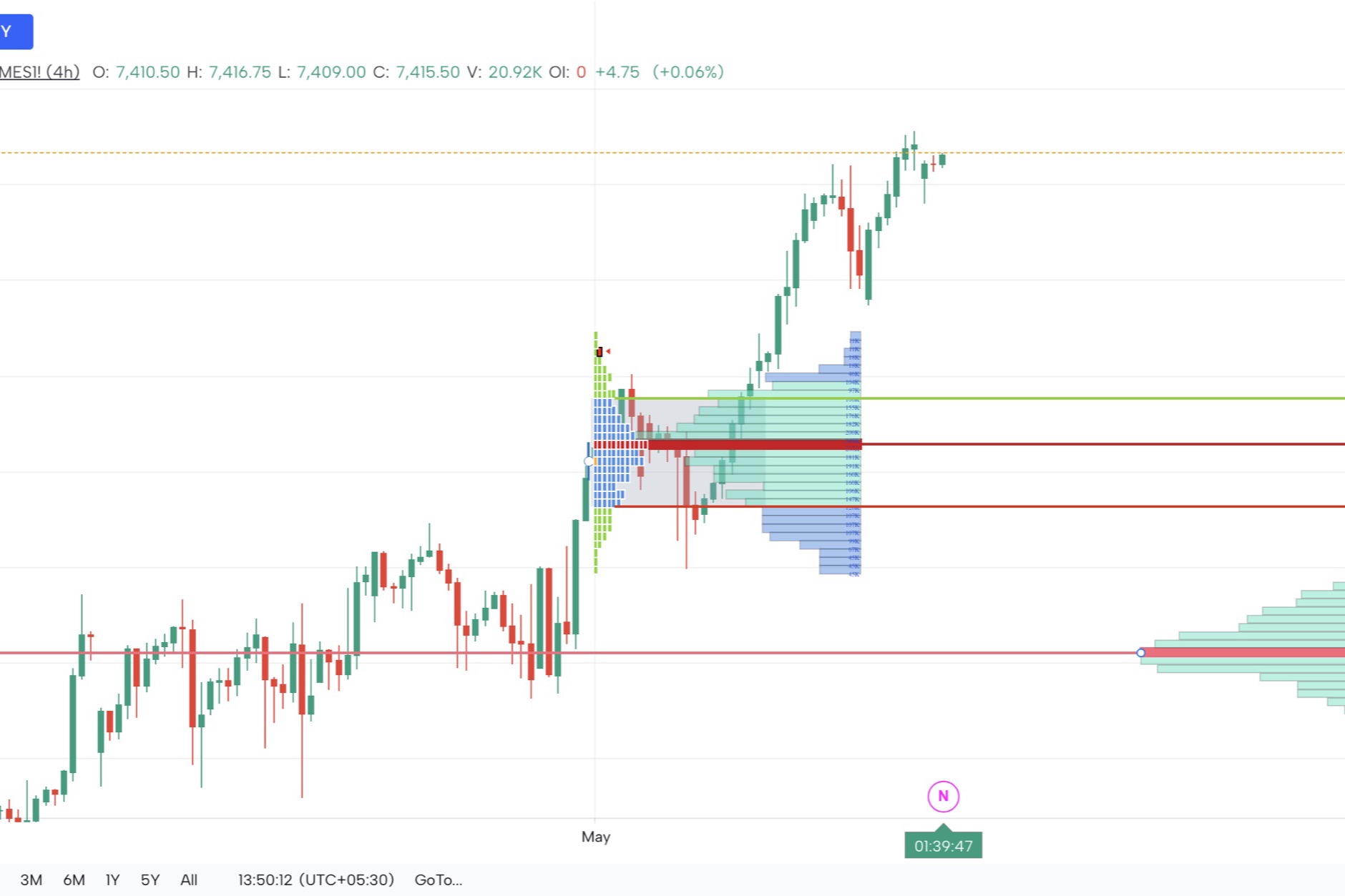
Market Profile is not an indicator. It is a way of organising the day’s trading so that the structure of the auction — where the market spent its time, where it accepted price, where it rejected price — becomes visible at a glance. Developed by Peter Steidlmayer at the Chicago Board of Trade in the 1980s, it has outlived most of the technical tooling that came after it because the underlying idea is simple and durable: markets are continuous two-way auctions, and the best way to read an auction is to look at the distribution of trade across price.
This is the long-form pillar guide. If you want the tighter operational view of the indicator itself, see the Market Profile Indicator: A Comprehensive Guide. This page covers the methodology end to end — auction market theory, anatomy of the profile, day types, open types, profile shapes, value-area logic, and how Indian intraday traders use the framework on Nifty and Bank Nifty.
What Market Profile Actually Is
A market profile chart takes a normal trading session and re-plots it sideways. Time becomes the x-axis you stop caring about and price becomes the axis the chart is built around. Every half-hour bracket of the session is given a letter (A, B, C, D…), and at each price the market traded during that bracket, the bracket’s letter is stamped. As the session unfolds, the letters stack up next to each other to form a horizontal histogram of time-at-price.
The histogram has a recognisable shape — usually a fat middle and thin tails. The fat middle is value: the price range where most of the day’s trading happened. The thin tails are excursions away from value where the market tested but was rejected. Inside the value band, one specific price will have the longest row of letters — the Point of Control, the price the market kept coming back to.
That is the entire chart. Everything else — day types, open types, profile shapes, value-area rules — is pattern recognition built on top of those three pieces.
Auction Market Theory: The Foundation
You cannot read a market profile without understanding why it is shaped the way it is. The framework is auction market theory, and three statements summarise it.
Markets exist to facilitate trade. Every market, every day, is a continuous auction looking for a price that will bring buyers and sellers together. When it finds one, volume builds. When it does not, the market moves elsewhere to look for one.
Time spent at a price is acceptance; time skipped over a price is rejection. A long row of TPOs at a price means the market accepted that level as fair. A skinny row means the market touched the level but kept moving — the auction did not clear there.
Value is the price range where most of the trade happened, not the average. The classical “value area” is defined as the price band containing 70% of the session’s TPOs (one standard deviation, in the original formulation). It is the band the market negotiated inside.
Once you internalise these three statements, every market profile chart starts to read itself. Also Read: Auction Market Theory For Day Trading
Anatomy of a Market Profile Chart
Five labels matter on every profile.
TPOs (Time Price Opportunities). The letters stamped at every price the market traded during each bracket. Each TPO is one half-hour spent at one price.
The Value Area (VA). The price range containing roughly 70% of the day’s TPOs. Its top is the Value Area High (VAH); its bottom is the Value Area Low (VAL).
The Point of Control (POC). The single price with the most TPOs in the day. The market’s centre of gravity. For a deep dive on POC behaviour see the Point of Control Trading Guide.
The Initial Balance (IB). The price range built during the first two brackets of the session — typically the first hour. The IB is the market’s opening statement: it sets a reference range that the rest of the day will either accept, extend or reject.
Single prints. Prices the market touched in only one bracket — TPOs that stand alone in the histogram. Single prints mark fast movement away from a level the market did not want to accept. They tend to act as magnets later.
Profile Shapes: D, P, b and Trend
The shape of the profile tells you what kind of day it is, often before the day is over.
D-shape (normal day). Fat middle, balanced tails on both sides. The market opened, rotated, found value, traded inside it. This is what a balanced auction looks like: ~70% of TPOs clustered in the value area, with single prints at both extremes.
P-shape. Heavy at the top, thin at the bottom — the profile looks like the letter P. Typically appears after a downtrend, where the morning sold off, then short-covering and value-buying drove price up and built a new value area higher. The fat top is short-covering; the thin bottom is the morning move that the market never came back to.
b-shape. The mirror image. Heavy at the bottom, thin at the top — the letter b. Long liquidation after an uptrend: morning rally, then a sell-off into a new lower value area. The thin top is the trapped longs; the fat bottom is the new acceptance.
Trend day. Almost no value area in the conventional sense — the profile is one long, thin distribution running diagonally. Trend days are the ones where the market opens, picks a direction, and runs without rotating back. They are rarer than they feel and almost always start with a recognisable open type (see below).
The shape on its own is descriptive, not prescriptive. Pair it with the open type and the previous day’s profile and you get a tradeable read.
The Five Open Types
How the day starts often dictates how it will trade. Five open types are worth knowing.
Open Drive. Price opens and immediately moves in one direction with conviction, never trading back through the opening price. Highest probability of a trend day. Strong open drives almost always print stacked imbalances on the footprint chart.
Open Test Drive. Price opens, briefly tests a level the other way (often the prior day’s high or low), then drives in the opposite direction. The test failed; the drive begins. Same trend-day potential as open drive.
Open Rejection Reverse (ORR). Price opens, moves one direction for a few brackets, then reverses cleanly and retraces back through the open. The classic head-fake morning. Often produces P-shape or b-shape profiles by the close.
Open Auction in Range. Price opens inside the prior day’s value area and stays there. Two-sided trade, no clear initiative. This is the rotation day — fade the value-area edges.
Open Auction Out of Range. Price opens outside the prior day’s value area but does not commit to direction. Mixed signals: the gap was meaningful, but follow-through is missing. Wait for the IB to complete before deciding bias.
The first hour of trading usually tells you which of these five you are looking at. The bias call you make from it carries through the rest of the day.
The Four Day Types
Once the session is done, every day fits into one of four classical types.
Trend Day. One-direction move with little rotation. Range expands all day; value-area location is meaningless because there is no value area. Range extension keeps printing in the trend direction.
Normal Day. A balanced day with the value area built largely inside the IB. The market opens, finds fair value, rotates around it. ~85% of trading happens inside the IB extended by 10-15%.
Normal Variation Day. Like a normal day but with one significant range extension — a single push outside the IB that finds new value and adds to the day’s range. Often produces P-shape or b-shape profiles.
Neutral Day. The market extends the IB on both sides during the session — a “neutral extreme” up and a “neutral extreme” down. It often closes near the day’s middle, undecided. Neutral days are the market’s way of saying it is between regimes.
The mix of day types tells you about the regime. A series of normal days is balance; trend days clustering together signal directional conviction; neutral days mark the chop where regimes change.
Value Area Rules: How Today’s Open Relates to Yesterday’s Value
The most useful day-trading framework that comes out of market profile is the open-relative-to-prior-value rule set.
Open inside prior value area. Highest probability of a rotation day. Trade the prior VAH and VAL as fade levels.
Open above prior VAH or below prior VAL. Gap-and-go potential. If the IB confirms the direction, the prior value area becomes a target only if the gap fails. If the IB extends in the gap direction, the prior value area is irrelevant.
Open inside prior value but immediately rejected. The classic ORR setup. The market is signalling that yesterday’s value is no longer fair; the day’s range will likely expand in the direction of the rejection.
These three rules will not catch every move, but they will keep you on the right side of most days. The framework is closer to a checklist than a predictive model — its value is in eliminating bad trades, not picking perfect ones. Also Read: Volume Profile: The Ultimate Guide
Naked POCs and Initiated Targets
Profile-based traders track three kinds of unfinished business across sessions.
Naked POCs. Prior session POCs that price has not yet returned to. They act as magnets — typically tested within five to ten sessions. The mechanics are explained in detail in the Point of Control Trading Guide.
Single-print extremes. Prices the market touched once in a single bracket and never came back to. They mark levels of high rejection and tend to be revisited when the auction structure resets.
Open gaps relative to the prior settle. Gaps measured against the prior session’s settle, not the prior close. They fill at a high rate when the gap is small and the open-type signal is mixed; they hold open when the open type is a strong drive.
Marking the chart with all three categories of unfinished business gives you a small set of high-conviction reference levels that the market tends to interact with.
Market Profile vs Volume Profile
The two are siblings, not the same thing. Both are price-distribution histograms; both have a POC and a value area. The difference is what they count.
Market Profile counts TPOs — half-hour brackets at each price. It measures time at price.
Volume Profile counts contracts — every trade at each price. It measures volume at price.
When the day’s volume is uniform across the brackets, the two POCs sit at the same level. When the morning traded heavy and the afternoon traded light, the volume POC will sit toward the morning prices and the market profile POC will sit closer to the time-weighted middle. Most professional desks use both — market profile for the auction structure, volume profile for the actual trade location, with both POCs marked on the chart.
Market Profile for Nifty and Bank Nifty Intraday
The framework translates cleanly to Indian indices, with a few specifics worth flagging.
Bracket size. A 30-minute bracket is the original Steidlmayer convention and works well for Nifty futures. Bank Nifty’s faster pace sometimes rewards a 15-minute bracket — same theory, finer resolution.
The Initial Balance window. With the Indian session opening at 09:15 IST, the IB completes at 10:15 (30-min brackets) or 09:45 (15-min brackets). This window is unusually informative on Indian indices because the global cash-equity flow finishes adjusting in the first hour.
Overnight gap as a regime tag. Nifty and Bank Nifty gap more often than US indices because of the overnight global session. Gap-and-go versus gap-and-fade behaviour is one of the most useful market-profile filters you can apply to Indian intraday.
Volume profile alongside. Indian retail option volume creates regular distortions in pure TPO profiles. Running a volume profile next to the TPO profile catches them.
The pattern reading is the same as any market — open type, profile shape, day type, value-area logic. The Indian-market filter is mainly about timing and gap behaviour, not different rules.
Building a Market Profile Trading Plan
A workable day-trading plan from this framework needs four pieces.
Reference levels marked before the open. Prior day’s VAH, VAL, POC. Naked POCs from the last week. Single prints to fill. Overnight high and low.
An open-type call within the first 30-60 minutes. Drive, test drive, ORR, range or out-of-range. This call sets the bias for the rest of the day.
A day-type hypothesis as the IB completes. Trend, normal, normal variation or neutral. This call sets the trade frequency: trend day = ride, normal day = fade.
Trade triggers from order flow. Profile gives you the location and the bias. Footprint and delta give you the entry. Pair the two layers and you have a structured intraday process. Also Read: What is Order Flow Trading?
Common Mistakes
Trading the profile without the auction logic. The shapes and rules look like a system, so traders apply them mechanically. Without the why — markets are auctions, time at price equals acceptance — the rules degrade into superstition.
Ignoring the open type. The first hour does most of the work. Skipping the open-type call means the rest of the day’s framework rests on no foundation.
Marking too many levels. Every prior day has a VAH, VAL and POC. If you mark them all, the chart becomes a Christmas tree. Three to five reference levels is the right density for an intraday chart.
Using market profile for ultra-short-term scalping. The framework was designed for the day-trader timeframe — 30-minute brackets, full sessions. It is not built to predict the next 15 seconds. For sub-minute decisions, switch to footprint and delta.
Trading Market Profile on GoCharting
GoCharting plots market profile and TPO charts natively, with developing profiles in real time, customisable bracket sizes, value-area shading, naked-POC tracking and split or merge logic for multi-day composites. The same chart supports volume profile and footprint side by side, so the auction context (profile) and the trade evidence (footprint and delta) are always on the same screen. Pair it with the Bookmap-style depth view for a complete order-flow workstation.
Conclusion
Market profile has outlasted four decades of indicator fashions because it answers a question the rest of technical analysis does not: where did the auction actually clear, and what does that tell you about where it will clear next? Learn the anatomy, the shapes, the open types and the day types. Mark the right reference levels. Combine the framework with order flow for entries. The result is a trading process that is both structured enough to be repeatable and flexible enough to handle whatever the day throws at you.
Frequently Asked Questions
1. Is market profile an indicator?
No. It is a way of organising trading data — a chart format, not a calculation overlaid on price. The “indicators” inside it (POC, value area, IB) are derived from the profile structure itself.
2. What is the difference between market profile and volume profile?
Market profile counts time at price (TPOs). Volume profile counts contracts at price. Both produce a POC and a value area, but on uneven-volume days the two POCs can sit at different levels.
3. What bracket size should I use?
30 minutes is the classical default and works for most futures. Faster instruments and high-pace indices like Bank Nifty sometimes benefit from a 15-minute bracket. Avoid sub-15-minute brackets — they fragment the profile.
4. Can market profile be used on stocks, not just futures?
Yes. The framework was developed on grain and bond futures but applies to any continuously traded instrument with reliable session boundaries — index futures, large-cap equities, liquid crypto pairs.
5. How long does it take to learn market profile trading?
Reading the basic anatomy is a matter of weeks. Reading day types, open types and profile shapes well enough to trade from them is usually a matter of months of screen time on a single instrument.
Related Documentation
Related Blog Posts
- Market Profile Indicator – A Comprehensive Guide
- Point of Control Trading Guide
- Volume Profile: The Ultimate Guide
- Auction Market Theory For Day Trading